Woodland place-names and the Ancient Woodland Inventory
Elizabeth is a PhD student in the department of Language and Linguistic Science at the University of York, whose thesis looks at place-names in the medieval period. She has been carrying out a placement at NEYEDC this summer, investigating how place-names can strengthen the evidence base for Ancient Woodland designation. In the second of two blog posts for NEYEDC, Elizabeth tells us more about place the source of place-names and how they’ve been used in her work on the Ancient Woodland Inventory.
Place-names appear in numerous medieval and early modern documents, from centralised administrative surveys like the Domesday Book, to local manorial, ecclesiastical and monastic records. The English Place-Name Survey (or EPNS), currently based at the University of Nottingham, was founded in 1924 to survey the origins and development of all English place-names. For each modern place-name, the EPNS aims to provide a comprehensive body of its early spellings for researchers and enthusiasts. This makes it possible to link past and present place-names, provided there is historical continuity (which is not always a guarantee, as noted in this blogpost)!
EPNS county surveys are available for all three historic ridings of Yorkshire (North, West and East). As part of my project, I reviewed these surveys to identify all place-names which indicate the historic presence of woodland, e.g. names containing a place-name element like wudu or vithr. I then narrowed down my search to place-names which still refer to a wooded area in the modern day (as opposed to a settlement or built-up area) and which have spellings that predate the first OS maps in the 1840s and 50s.
Case Study 1: Previously designated Ancient Woodland
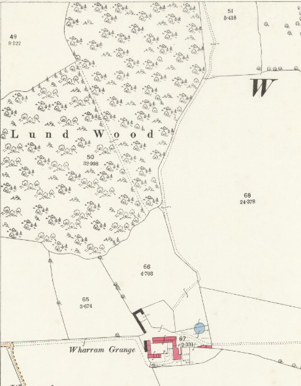
OS Yorkshire CXLIII.5, published 1890. Reproduced with the permission of the National Library of Scotland.
Many woods in North and East Yorkshire have names which go back centuries. For instance, Lund Wood in Wharram le Street, East Yorkshire, is first recorded as Thornlund (‘thorn wood’, Old English thorn + Old Norse lundr) in a cartulary (the collection of records belonging to a monastery) from nearby Meaux Abbey in 1154. It is then attested multiple times under the same name in documents from the twelfth to fourteenth centuries. Lund Wood is already designated Ancient Woodland, but the place-name evidence further suggests that it is of great age.
Case Study 2: Potential new Ancient Woodland
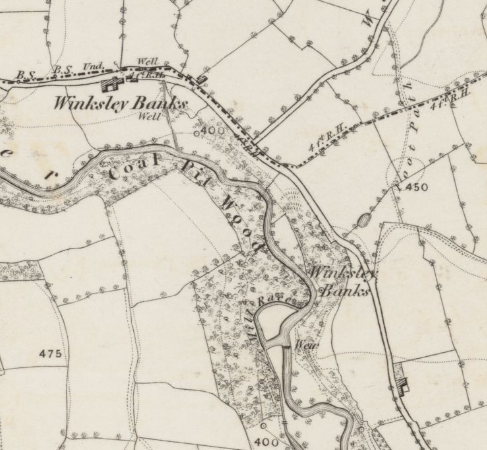
OS Yorkshire sheet 118, published 1854. Reproduced with the permission of the National Library of Scotland.
Place-name evidence also affirms the status of some potential new Ancient Woodlands identified during NEYEDC’s Ancient Woodland Inventory update. Coal Pit Wood, in Winksley, North Yorkshire, was designated as Ancient Woodland with low confidence on the basis of eighteenth-century map evidence. The EPNS gives its first attestation as Colpothscogh (literally meaning ‘coal pit wood’, from Old Norse skogr) in a cartulary of Fountains Abbey from 1259, lending further support to this designation.
Case Study 3: Long Established Woodland
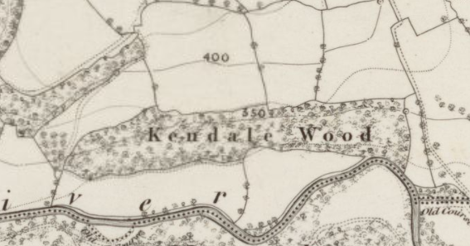
OS Yorkshire sheet 118, published 1854. Reproduced with the permission of the National Library of Scotland.
Finally and most excitingly, some sites designated as Long-Established Woodland in the Ancient Woodland Inventory (i.e. wooded areas which first occur in the earliest OS maps in the mid-nineteenth century) have place-names spellings which go back further than this, making a potential case for redesignation as Ancient Woodland. Kendale Wood, also in Winksley, is currently designated as Long-Established Woodland due to a lack of available evidence. However, according to the EPNS, it is first recorded in Latin as bosco vocato Kendalebanke (‘wood called Kendalebanke’, from Medieval Latin boscus, meaning ‘wood’) in a 1479 document associated with Ripon Cathedral. The wood is likely to have been named after a John Kendale mentioned in the same document, presumably its owner.
Incidentally, the name Winksley itself is a compound of the Old English personal name Winuc and leah ‘woodland clearing,’ suggesting the village may have been originally settled in an area of cleared woodland. On multiple levels, then, the place-name evidence indicates that Winksley was historically a well-wooded parish.
Overall, place-names offer a rich and previously unexploited source of evidence on historical wood coverage in Yorkshire, which can be used to great effect alongside other types of data (e.g. ecological surveys) to inform Ancient Woodland designations.