Woodland place-names - how do they work?
Elizabeth is a PhD student in the department of Language and Linguistic Science at the University of York, whose thesis looks at place-names in the medieval period. She has been carrying out a placement at NEYEDC this summer, investigating how place-names can strengthen the evidence base for Ancient Woodland designation. In the first of two blog posts for NEYEDC, Elizabeth tells us more about place names and how they relate to woodland.
Historically, most place-names originated as descriptive phrases about landscape or settlement features. This makes them a useful and fascinating source of information on landscape history.
How do place-names work?
In Yorkshire, many place-names are of Old English or Old Norse origin, or else developed from later dialect terms that were derived from these languages. Old English was the language of the Anglo-Saxons, while Old Norse was spoken by the Viking invaders who settled in Yorkshire from the late ninth century onwards. Both Old English and Old Norse are Germanic languages, meaning they share some cognates – words which developed from the same root in their parent language, Proto-Germanic, and have identical or similar meanings.
Place-names in Germanic languages are typically formed by compounding together two elements (words used in place-name formation). The first of these elements, the specific, gives specific detail about the site, while the second, the generic, serves as a more general descriptor. For instance, Beverley (E Yorkshire) is made up of the two Old English elements beofor ‘beaver’ (specific) and licc ‘stream’ (generic), meaning ‘beaver stream’.
Name elements indicating woodland
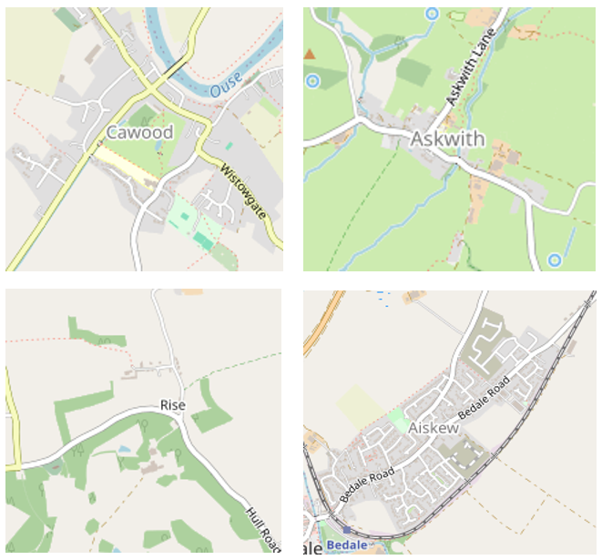
Yorkshire settlement names with wood-related meanings. From top left going clockwise: Cawood, North Yorkshire (‘jackdaw wood’, Old English cā ‘jackdaw’ + wudu); Askwith, North Yorkshire (‘ash wood’, Old Norse askr ‘ash tree’ + vithr); Aiskew, North Yorkshire (‘oak wood’, Old Norse eiki ‘oak’ + skogr); and Rise, East Yorkshire (Old English/Old Norse hrisum, ‘at the brushwood’). Map data from OpenStreetMap.
In medieval times, woodland was a valuable natural resource. Numerous generic place-name elements indicate the presence of woodland in an area. In Yorkshire, among the most common of these are Old English wudu (usually spelt as wood in modern place-names) and its Old Norse counterpart vithr (usually spelt with), both meaning ‘wood’. Another pair of cognates is Old English sceaga (which becomes shaw in modern English) and Old Norse skogr (found with a variety of later spellings, including scoe, skew and scogh), which both refer to a small wood, thicket or copse. Old Norse lundr (lund in later spellings) similarly describes a small wood or grove, while Old English fyrhth(e) (firth or frith) and Old English or Old Norse hris (rise) are used for areas of scrubland or brushwood. Old English wald, the source of the name for the Yorkshire Wolds, is more complicated: it originally referred to downland forest, but later came to mean something more along the lines of ‘open high ground’.
Name elements indicating woodland clearance
Generic place-name elements referring to woodland clearance are also common. Chief among these are Old English leah (-ley or -leigh) and Old Norse thveit (-thwaite), which describe woodland clearings, pastures and glades. Old Norse hǫgg, which later evolved into the dialectal term hagg, originally referred to a part of a coppice wood marked off for felling. Old English rydding (rudding or riding in later spellings) and stubb similarly denote woodland clearings or areas of tree stumps. These names can also serve as evidence of wood coverage, since the presence of a woodland clearing suggests, by implication, the presence of woodland. If traditional woodland management practices are followed, an area of cleared woodland will often regrow - hence the large number of ‘Hagg Woods’ in Yorkshire!
In many cases, the wood which a parish or settlement was named after no longer survives, or is unidentifiable. Aiskew parish, for instance, now only contains sparse fragments of woodland. However, in some instances, it’s possible to trace the name of a wooded area from medieval times to the modern day by examining old documents and maps. In the next blogpost, I give some examples of how this can be used to strengthen the evidence base for Ancient Woodland designations.
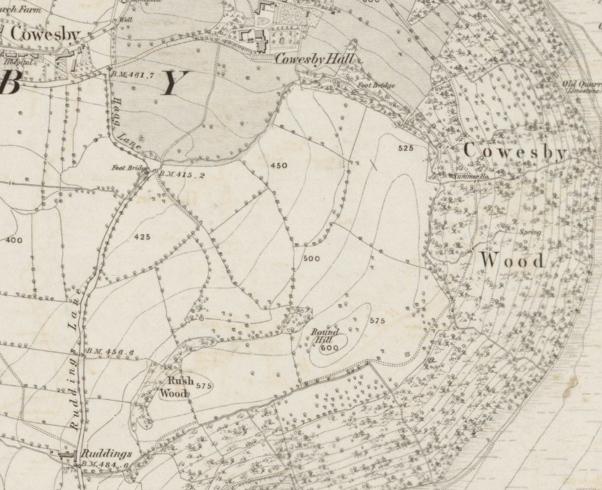
Cowesby Wood, near Cowesby, North Yorkshire, is designated Ancient Woodland. The lane running along the valley to the west of the wood is called alternately “Hagg Lane” and “Ruddings Lane,” suggesting an area where the wood has been cleared for passage. OS Yorkshire Sheet 72, reproduced with the permission of the National Library of Scotland.
Sources/further reading
Margaret Gelling and Ann Cole, The Landscape of Place-Names. (Shaun Tyas, 2000)
George Redmonds, A Vocabulary of Wood, Wood-Workers and Wood Management in Yorkshire. (Shaun Tyas, 2017)
Albert Hugh Smith, English Place-Name Elements, Volumes 1 and 2. (Cambridge University Press, 1956)