#99 Skylark by Paul Hankin
Meet Paul Hankin, a Yorkshire Birder!
After graduating, Paul spent three years as a manager on a 600+ acre farm in Kent. It was intensively farmed and roughly divided up as 100 acres of iceberg lettuce, 100 acres of soft fruit and 100 acres of newly planted, irrigated apple orchards, the remainder being down to cereals and woodland. They had an on-site packhouse and supplied all the major multiple retailers.
From here his career took him to work for several of the retailers in a variety of technical roles with product responsibility, and also to working for a major juice and drinks brand, visiting raw material suppliers wherever in the world they may be.
Paul first became aware of his chosen species in his early teens when, joined by his best friend, who was a farmer’s son, they would help-out on the small farm in West Lancashire that was owned by his parents.
Whilst hoeing cabbages or, later in the year, standing on the potato harvester, Paul would hear them high above - but they were almost always impossible to spot because of their small size and the height at which they hovered.
The desire to find out about this bird and others led Paul to join the Young Ornithologists Club (YOC), where for the annual membership you received a monthly magazine and, upon joining, were sent a pin badge of a kestrel to wear. Whilst out and about on his bike in the local countryside, he would look to see which birds were nesting where, and the success or otherwise of the nest. He would get very upset if the nest was raided by magpies or by boys from the nearby town, who would take the eggs if they found a nest.
Paul doesn’t consider himself a twitcher, though his work has given him the opportunity to travel worldwide on a regular basis with plenty of opportunity to observe the local wildlife. His observational interest in birds of the garden and field in the UK has, however, remained.
Paul’s chosen species is one of our iconic farmland birds, the Skylark Alauda arvensis. The Skylark is a small bird, about 18 cm in size with cream/buff, brownish upper parts and streaked under-parts and breast. It has a longish tail and a short crest.
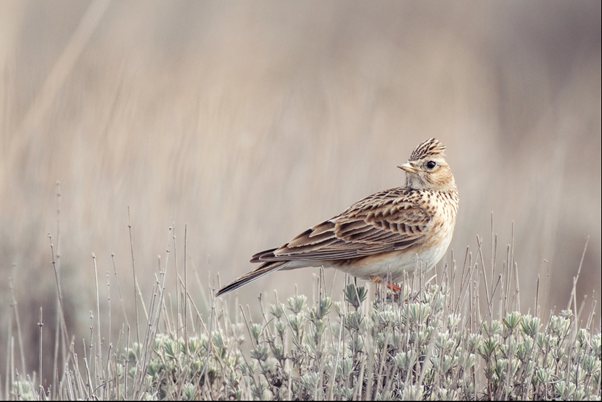
Skylark (RSPB Trends Explorer)
It is ground nesting and prefers open habitats. The highest densities are found in arable land, grass moors, salt marshes and peatlands as these provide better conditions - ground cover that is not so short that their nests are exposed but also not so high that it makes it difficult to flit from place to place across the ground. They are ground nesting, and as such are subject to predation risk. They generally have three or four broods, laying three/four eggs each time and with the chicks becoming independent around twelve days from hatching.
Their diet is mainly of seeds and vegetable matter but also inspects, especially when feeding their young.
On spring and summer days the Skylark can be seen rising almost vertically then hovering overhead whilst singing “the silver chain of sound of many links without a break” continuously, sometimes for up to 5 minutes without pause, before plummeting back to the ground.
The Skylark is also one of our most celebrated birds in literature, poetry, art, and music, for example, in P.B Shelley’s poem ‘To a Skylark’ or in Shakespeare’s works, where the ‘lark’ is referenced in over 15 plays and poems. Whilst the Skylark is often used as a device in literature to represent freedom, joy, and optimism, in Romeo and Juliet, Juliet also references the folklore that the lark ‘traded its eyes’ with the Toad, giving the lark unattractive eyes and the Toad unattractive ones. In Shakespeare’s time, Skylarks were abundant and often kept as caged pets. Often, the birds would be blinded in the (mis)assumption that it would enhance their song. The Skylark and its music have also been used as a literary device in the works of Chaucer, John Milton, William Browne, and others. It is also the subject of the well-known Ralph Vaughan Williams classical music piece “The Lark Ascending”, which is believed to have been inspired by a George Meredith poem of the same name and where a violin undulates and soaring occasionally to some very high notes above the orchestra.
The Skylark has also had a part to play in our language in that the saying “up with the lark” is believed to have come from the Skylark being one of the first birds to sing at dawn and the phrases “Skylarking” and “larking about” having originated from British sailors playing games in the top rigging of sailing ships.
Unfortunately, the numbers of Skylark in the UK suffered a sharp decline in the 80s and 90s - down 63% since 1967, due to changes in agricultural practices and habitat loss, namely a move to autumn sown cereals and intensive grassland management with earlier cutting of grass meadows.
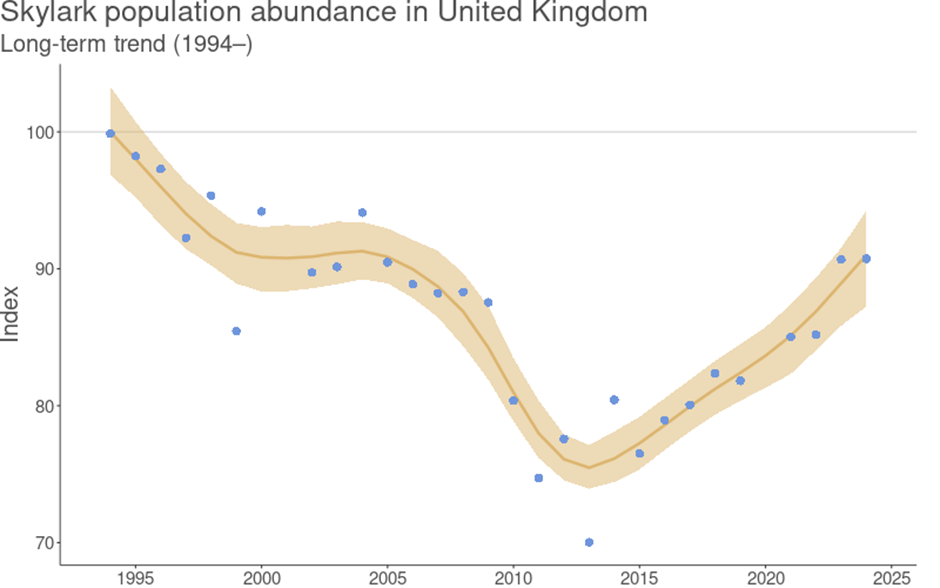
Graph showing Skylark decline and rise since the 1990s.
Consequently, the Skylark is on the Birds of Conservation Concern Red List despite counts showing that in Yorkshire and Humber, numbers have been more stable in the last 2 decades and with a national increase of 9% and nearly 20% in Eastern England. Such is the significance of the change in agricultural practices that the RSPB has issued Skylark conservation advice for farmers, which includes the creation of Skylark plots in winter grown cereals to support their nesting behaviour.
In recent years, local studies have taken place, such as those undertaken by the Yorkshire Dales National Park and the Sheffield and Rotherham Wildlife Trust with ongoing monitoring by the RSPB and BTO.
More recently, Skylark mitigation studies have been carried out and included in renewable energy planning applications, especially with regard to the impact of solar farms on this vulnerable species.
Recording and monitoring
The Skylark is one of the 19 species that makes up the UK Farmland Bird Indicator and is monitored by the BTO in schemes such as the Breeding Bird Survey and Nest Record Scheme. You can submit records of Skylark sightings to the BTO to contribute to this knowledge and can also share this with your local LERC.
Further information and acknowledgements
NEYEDC would like to thank Paul for his time and expertise in helping to create this blog.